
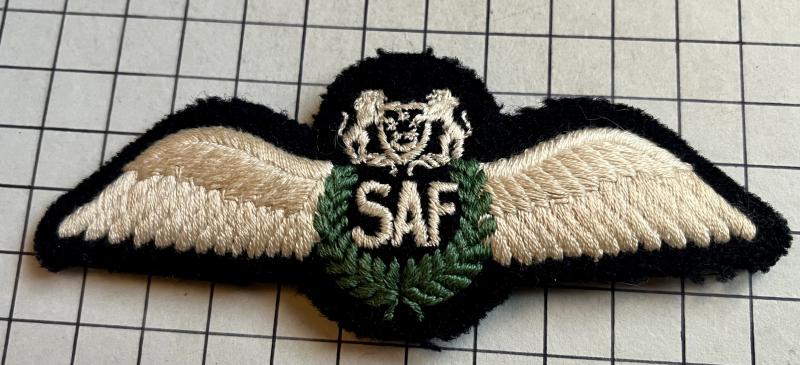
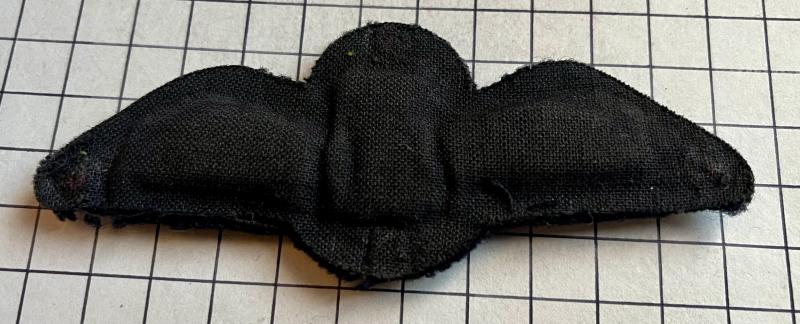
c1968-75 Singapore Air Force (SAF) Armed Forces Cloth Padded Pilot Wing
S.A.F. Stands for the Singapore Armed Forces. Pilots wore this type of wing between 1968 and 1975. During that time, the air arm originally operated as the Singapore Air Defence Command (SADC), which fell directly under the broader SAF umbrella. In 1975, the service was officially renamed the Republic of Singapore Air Force (RSAF). Following this change, the lettering on the pilot wings was updated to "RSAF", making the older "SAF" variants highly collectible pieces of Singaporean military insignia.
In January 1968, the United Kingdom, which by this time had lost most of its global prestige especially after the Suez Crisis and was facing major financial difficulties that were greatly exacerbated by the devaluation of the pound, announced the imminent withdrawal of all its troops "East of Suez" by the end of 1971.Prior to then, Singapore had depended heavily on Britain's Royal Air Force (RAF) for its air defence, while the newly established Singapore Armed Forces (SAF) had concentrated its efforts mainly on building up the land-based Singapore Army.
The predecessor to the RSAF, the SADC, was formed on 1 September 1968. The SADC's immediate task was to set up the Flying Training School to train pilots. Qualified flying instructors were obtained through Airwork Services Limited, a company specialising in defence services. Basic training for pilots was carried out using two Cessna light aircraft hired from the Singapore Flying Club. The SADC also enlisted the help of the Royal Air Force which introduced the first flying training syllabus and provided two ex-RAF pilots as instructors, as well as facilities and services at Seletar Airport. Finally, the first batch of six pilot trainees were sent to the United Kingdom in August 1968 to undergo training in various technical disciplines. The training was based on the Hawker Hunter, the SADC's first air defence fighter. The following month, another pioneer group of technicians, this time from the rotary wing, were sent to France to begin their technical training on the Aérospatiale Alouette III helicopter. In 1969, a number of local RAF technicians were released to join the fledgling SADC. These local technicians (local other ranks) had experience working on fixed-wing RAF aircraft such as the Hawker Hunter, Gloster Javelin, English Electric Canberra, English Electric Lightning and Avro Shackleton; as well as rotary-wing RAF aircraft such as the Bristol Belvedere, Westland Wessex and Westland Whirlwind.
Eight Cessna 172K aircraft—the SADC's first—arrived in May 1969 to be used for basic pilot training. By December, the first batch of students completed the course. Of these, six were sent to the UK to receive further training. On their return to Singapore in 1970, they were ready to operate the then newly acquired Hawker Hunter fighter aircraft.
The pace of training pilots and ground crew picked up gradually. On 1 August 1969, Minister for the Interior and Defence, Lim Kim San, inaugurated the Flying Training School (FTS) at Tengah Air Base (then known as RAF Tengah). The inauguration of FTS brought SADC closer to its goal of fulfilling the heavy responsibility of defending Singapore's airspace.
The subsequent arrival of the BAC Strikemasters in 1969, used for advanced phase flying training, meant that pilot trainees were now able to earn their initial wings locally rather than overseas. The first batch of locally trained fighter pilots were trained at the FTS and graduated in November 1970. Amongst this batch was 2LT Goh Yong Siang, who later rose to the appointment of Chief of Air Force on 1 July 1995. Gradually, the SADC had its own pilots, flying instructors, air traffic controllers, and ground crew.
When Britain brought forward its plan to withdraw its forces by September 1971, the SADC was suddenly entrusted with a huge responsibility and resources. Britain's former air bases—Tengah, Seletar, Sembawang and Changi—were handed over to the SADC, as well as its air defence radar station and Bloodhound II surface-to-air missiles.
In 1973, the SADC procured Shorts Skyvan search-and-locate aircraft and Douglas A-4 Skyhawk fighter-bombers. With a reliable mix of fighters, fighter-bombers, helicopters and transport aircraft, the SADC was ready to assume the functions of a full-fledged air force. On 1 April 1975, the SADC was renamed the Republic of Singapore Air Force (RSAF).
Code: 2402
120.00 GBP