
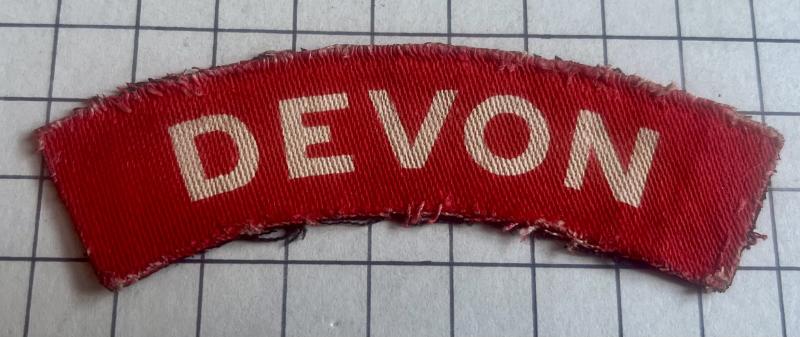
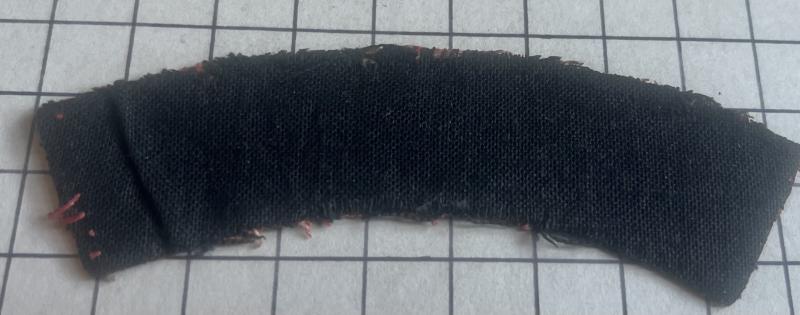
c1943 - 45 WW2 Devonshire Devon Regiment Printed Shoulder Title Badge Patch
cWWII Devon Regt printed shoulder title removed from Uniform / Battle Dress. GC.
In May 1943, the 6th Airlanding Brigade was created with the 1st Royal Ulster Rifles and the 2nd Oxford & Buckinghamshire Light Infantry forming its experienced nucleus. The 12th Devonshires, having been selected to fill the post of the remaining battalion, arrived soon after. For all units of the 6th Airborne Division the following months were ones of hard and constant training so as to ensure that it would be fully prepared for the Invasion of France.
Normandy
It had originally been intended that the 6th Airlanding Brigade would land with the first wave of Airborne troops to secure the Ranville and Bénouville Bridges, however the discovery of considerable anti-glider defences on their intended Landing Zone resulted in their arrival being delayed until the evening of D-Day. Even so, there were not sufficient numbers of aircraft available to enable the 6th Airborne Division to fly to Normandy in two lifts, which required several units to travel by sea and so delay their arrival on the battlefield until the 7th June. The 12th Devonshires were one such unit, with the exception of their "A" Company, for which enough aircraft had been found to transport them to LZ-W on the evening of the 6th June with the remainder of the 6th Airlanding Brigade.
The 6th Airborne Armoured Reconnaissance Regiment also arrived on this lift, and it had been intended that they, with "A" Company and the 211th Airlanding Light Battery under command, would form an armoured group whose purpose was to roam the Divisional area and intervene wherever they felt it necessary. By the time that the Second Lift arrived, however, the Division was so lacking in infantry strength, due to the scattered drop of the 3rd and 5th Parachute Brigades, that this plan was abandoned and the Devons reverted to a standard defensive role. When the remainder of the Battalion arrived on the 7th June, they relieved the beleaguered 12th Parachute Battalion at Le Bas de Ranville.
During this first night, "B" Company suffered three dead and sixteen wounded when enemy aircraft released anti-personnel munitions over their position. Pressure was maintained on the Battalion during the 8th June with an artillery bombardment that began at 11:00 and lasted until the evening. On the following day, at 19:00, another heavy bombardment was directed against the whole of the Division's southern flank, followed up an hour later by a determined infantry attack on the 12th Devonshires. This engagement proved to be the Battalion's toughest test of the Invasion with the Germans managing to break into their positions, however the Devons swiftly counterattacked and threw back the attackers. Half an hour later, "A" Company were challenged by three companies of infantry supported by armoured vehicles. Despite a British artillery bombardment and the accurate fire of "A" Company's rifles and Vickers Medium Machine Guns, the Germans managed to close to within fifty yards of their positions before sheer volume of fire finally repulsed them with heavy losses. Having made no progress with such attacks, this proved to be the last serious attempt that the Germans made to interfere with the southern flank of the 6th Airborne Division.
Until mid-August, the Division was concerned only with a static defence and a vigorous programme of patrols and sniping to prevent their opponents to the east from becoming settled. This routine came to an end on the 17th August, when the Division began to follow up the German withdrawal in their area. The 6th Airlanding Brigade, with the Princess Irene and 1st Belgian Brigades under command, took the northern coastal route while the main force focused on securing a crossing over the River Dives further south. "B" Company initially led the way northwards and were soon brought to a halt by a German rearguard, however this resistance was overcome following an exchange of fire and the intervention of the 53rd Light Regiment's guns, the Battalion's mortars, and a troop of Belgian armoured cars. Thereafter the 1st Royal Ulster Rifles resumed the advance on Cabourg, and after several fruitless attempts to force a crossing over the River Dives, the 6th Airlanding Brigade was ordered to follow the main Divisional advance to the south, and then proceed along the roads in between this main thrust and the 1st Belgian Brigade's advance along the coastal road. For the most part, the 12th Devonshires acted as the Brigade reserve.
On the 25th August, the 6th Airborne Division received orders to halt its advance on the western bank of the River Risle, and in early September it men returned to England to prepare for future operations.
The Ardennes and Holland
The Division was unexpectedly called back to Europe on the 20th December 1944, to help contain the German offensive in the Ardennes forest region. The Battalion's actions here were largely confined to patrols and minor skirmishes. Several months of similar activity followed in various parts of Belgium, and later Holland, before the Division was withdrawn to England to prepare for the final assault on Germany.
The Rhine Crossing
As part of Operation Varsity on the 24th March 1945, the 6th Airlanding Brigade was to land each of its battalions on separate drop zones around the village of Hamminkeln. The 12th Devonshires were ordered to land at LZ-R, to the south-west of the village, and then proceed to secure the two western roads leading out of Hamminkeln, thereby cutting off the possibilities of retreat or reinforcement of the garrison, before assaulting the village itself. To assist them in this endeavour, the 3rd Airlanding Anti-Tank Battery, minus three of their 17-pounder guns, were placed at their disposal.
Code: 2098
120.00 GBP