
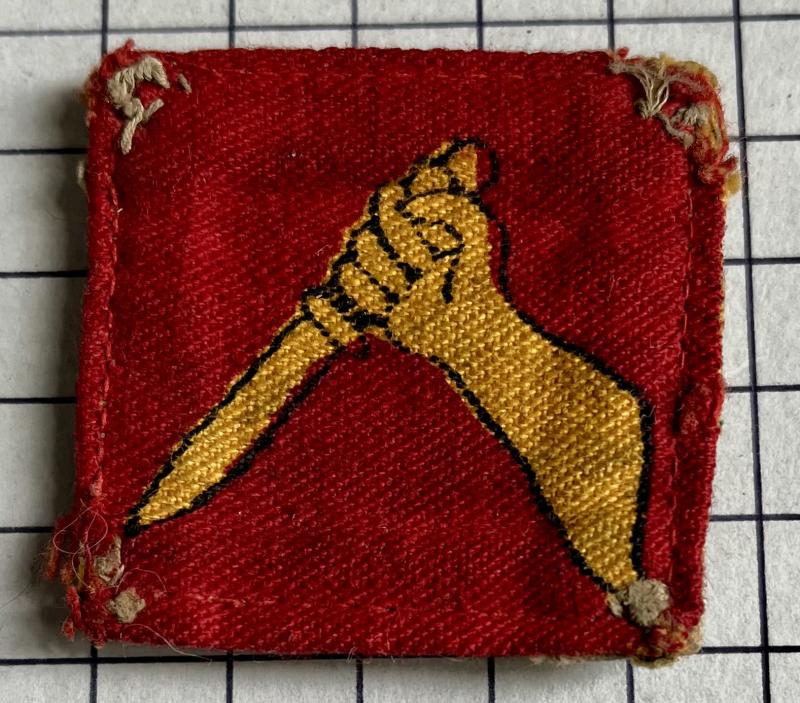
cWW2 19th Indian Division Printed Cloth Formation Sign Badge Patch
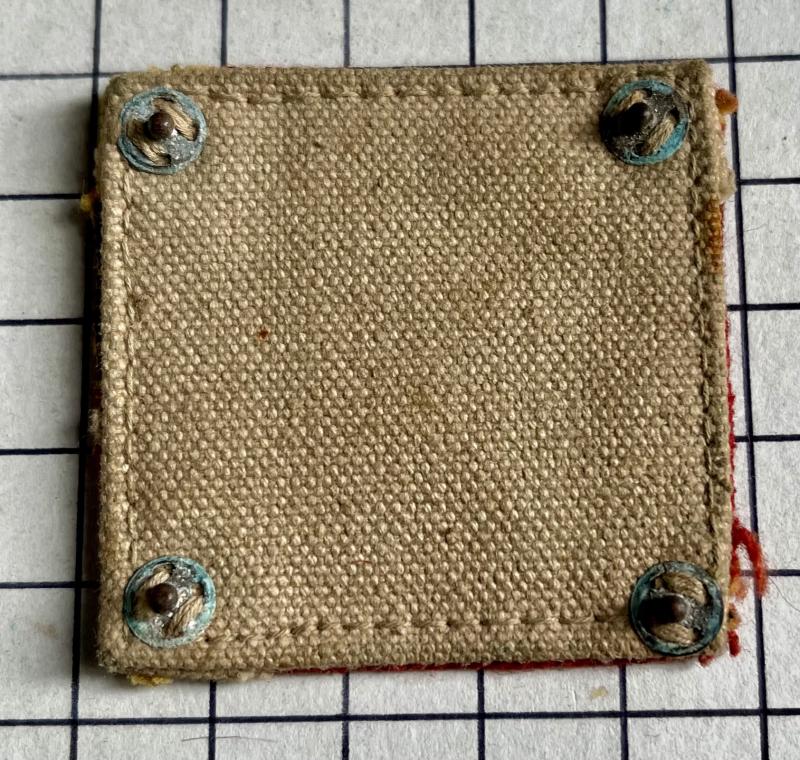
cWWII, 19th Indian Div Formation Sign with poppers to reverse. VGC.
After short periods under the command of Major General Geoffry Scoones and Douglas Stuart the division in October 1942 came under the command Major General Thomas Wynford Rees, who was to become GOC until December 1945. The division spent an extended period on internal security duties and in training before being committed to the Fourteenth Army, commanded by Lieutenant General Sir William J. "Bill" Slim, on the Burma front in July 1944.1 From October the division concentrated on the Imphal plain under IV Corps and from November its brigades were involved in operations on the Chindwin River advancing to establish contact with the British 36th Infantry Division advancing from the north on their left.1 Concentrating once more at Sinlamaung the division came under Indian XXXIII Corps, and played the major role in the capture of Mandalay which was completed on 20 March. Transferred to IV Corps, it guarded the Fourteenth Army's lines of communication and mounted an offensive towards Mawchi, in the Kayah State.
The division's successes were due to its fitness and high morale. It had a high proportion of pre-war regular soldiers among its officers and senior Non-Commissioned Officers. The 19th Indian Division was occasionally referred to as the "Dagger Division", from its divisional sign, which was a hand thrusting a dagger overhand, in yellow on a red background.
During the Second World War, a large number of brigades were assigned or attached to the division. The included at various points the 9th, 47th, 48th, 49th, 62nd, 64th, 98th and 99th Indian Infantry Brigades as well as the 22nd (East Africa) Infantry Brigade.
Code: 2065
40.00 GBP