
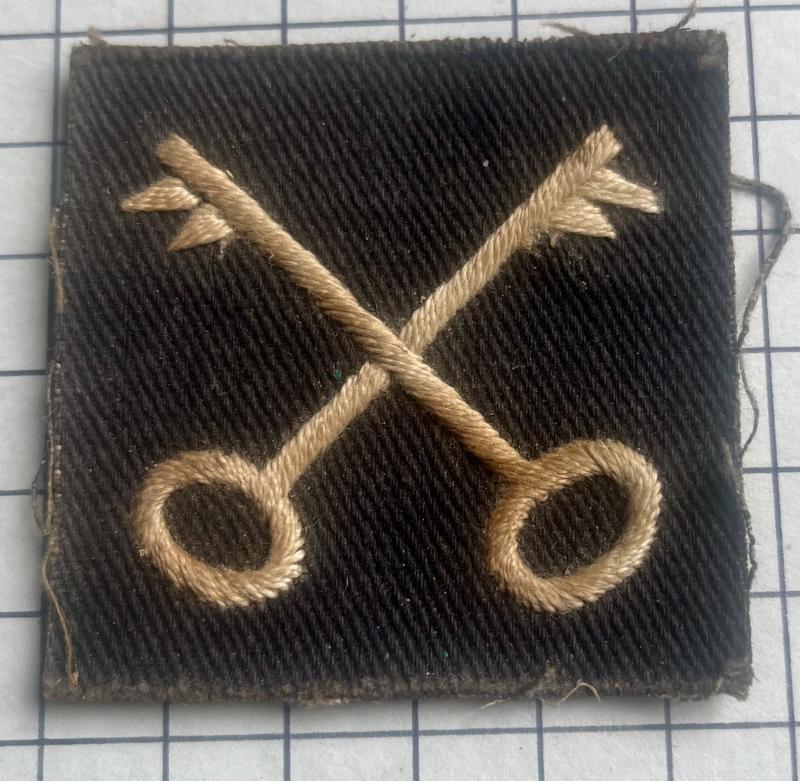
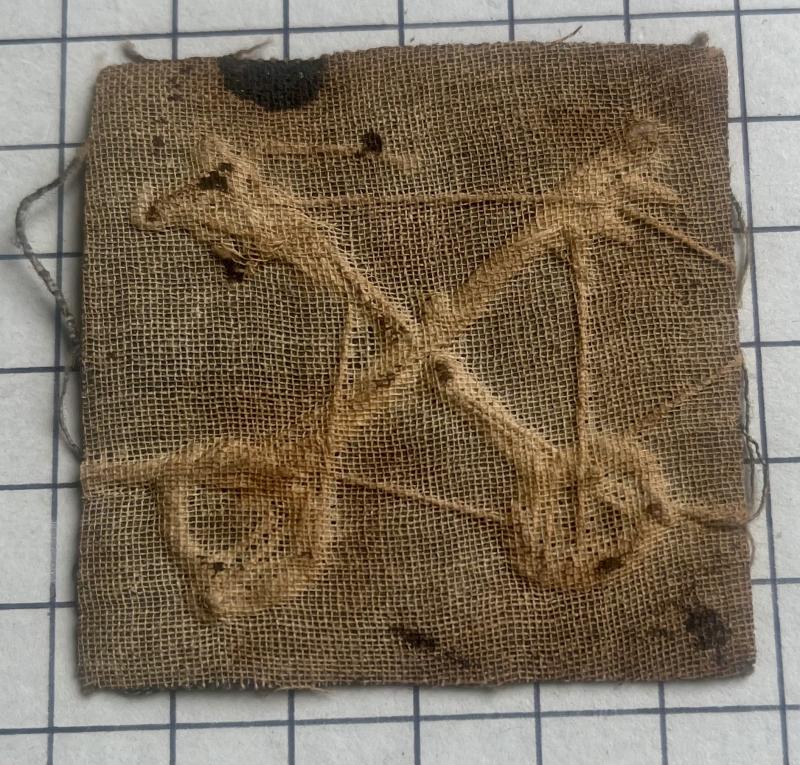
c1942-46 cWW2, 2nd Division Indian Burma Campaign Locally Made Formation Sign Badge Patch
cWWII, scarce Indian / Burma made 2nd Div crossed keys embroidered cloth formation sign. GC.
Ref: BoBD 3614 p.757.
India and Burma
The division arrived in India in July 1942, and was based initially at Poona before it established itself at Ahmednagar. In Asia, following the Empire of Japan's entry into the war in December 1941 and the conclusion of the Malayan campaign and the Battle of Singapore, the Burma campaign was the primary theatre of operations where British forces were engaged against those of Japan. Because of the logistical issues at the time, the division could not be employed in Burma. Instead, the division formed part of the British strategic reserve in Asia. In July, as a result of the German advance into the Caucasus region of the Soviet Union, the 2nd and the 5th Divisions were selected to be deployed to the Kingdom of Iraq if German forces entered the Middle East. Concurrently, an Axis advance into Egypt was stopped at the First Battle of El Alamein, in July 1942. In August the two divisions were again offered as reinforcements to move into the Middle East. No move was undertaken, as a result of the defeat of the Axis forces at the Second Battle of El Alamein (October and November 1942). This battle followed the defeat of German forces during the Battle of Stalingrad (August 1942 – February 1943), removed the threat to the Middle East.174175176 In November 1942 the division's 6th Infantry Brigade was detached and assigned to several British Indian Army formations, and fought in the Arakan Campaign in Burma. It returned to the division in June 1943.177
The 2nd Division spent 1942 to 1944 training at its Ahmednagar base. It dispatched one brigade at a time to conduct jungle warfare training near Belgaum, and also sent troops to Bombay to undertake combined operations training. Amphibious warfare training took place as well, as the division has been assigned to take part in Operation Anakim. This operation, scheduled for November 1943, was a proposed landing that would take place at Rangoon as part of a larger effort to retake Burma. Developments around the other theatres of the war caused a shortage of shipping to India, which resulted in the continued postponement to this operation.171172178 During 1943, the division made preliminary preparations for a move to Tehran, Iran, but ultimately did not go.172 Shifting Allied plans for the reconquest of Burma saw the division, by late 1943, assigned to Operation Bullfrog. Rather than an assault on Rangoon, this proposed amphibious landing would take place near Akyab, on the Arakan coastline of Burma. Like Anakim, this would be in conjunction with a new offensive into Burma. By January 1944 this and all amphibious operations had been cancelled along with the proposed deployment of the division.179
The following month, the British frontline started to prepare for an expected Japanese offensive.180 In March Japan invaded India, and then besieged Imphal and Kohima. In response the 2nd Division was assigned to the British Fourteenth Army and ordered to move to Chittagong. As a result of the fighting at Kohima, the division was diverted to the province of Assam. After a move of 2,000 miles (3,200 km), the division launched a counter-attack on 12 April. In conjunction with the 7th Indian Infantry Division, the division broke the Japanese siege of Kohima and forced them to retreat.181182 Advancing towards Imphal, the division fought several actions with Japanese forces. On 20 June the division linked up with British Indian forces who had advanced from Imphal, which ended that siege. In the course of this fighting, the division assisted in the destruction of the Japanese 31st Division, and suffered 2,125 casualties.183184
Tommies of the 1st Battalion, Dorset Regiment, moving into Ywathitgyi to relieve the 1st Battalion, Royal Scots, who captured the town, February 1945.
British infantry reinforcements within India were scarce. To maintain the division in the field and make up losses, several British anti-aircraft units in the theatre were disbanded. This released around 3,500 British soldiers, of whom 2,500 were dispatched to the 2nd Division.185 In November the division started to move towards Burma, and by 7 December was concentrated across the border at Yazagyo. As part of Operation Capital, the 2nd Division then advanced 150 miles (240 km) and captured several important airfields that were required for the supply effort for the advance to Mandalay. At the end of 1944 the division was near Shwebo, north of Mandalay. Heavy rain delayed progress, and the city was not captured until 11 January 1945. In the opening three months of 1945, the division took part in the Battle of Meiktila and Mandalay. This culminated with the capture of the latter on 21 March, in part by the division.184186 While the main advance proceeded to Rangoon, the division cleared bypassed Japanese positions near Mandalay.184 As the reconquest of Burma entered its final stage, those forces that were not going to be used were withdrawn to India. The 2nd and the 36th infantry divisions were selected to be relieved because of the increasing shortage of British manpower in Asia, which impeded the ability to maintain them at full strength. This was, in part, the result of the "python" scheme that aimed to repatriate soldiers who had served in Asia for at least three years and eight months back to the UK. The 2nd Division left their transport in Burma, and the troops were flown to India between 10 and 20 April.187
In India, the division was transported to Calcutta, where it was re-equipped and assigned to Operation Dracula – an amphibious assault on Rangoon. In the event, the city was liberated by other forces and the 2nd Division did not depart for the port.184188 With Burma retaken, the British set their sights on the recapture of Malaya. An amphibious landing, codenamed Operation Zipper, aimed to land forces along the Malayan coastline and then liberate Singapore. The 2nd Division was not chosen to take part in this operation, as 10,000 of its troops were due to repatriated during 1945, but did provide communication and administrative assistance.189 The surrender of Japan forestalled this endeavour, and the division ended the war back at Poona. Disbanded 1946.
Code: 2037
40.00 GBP