
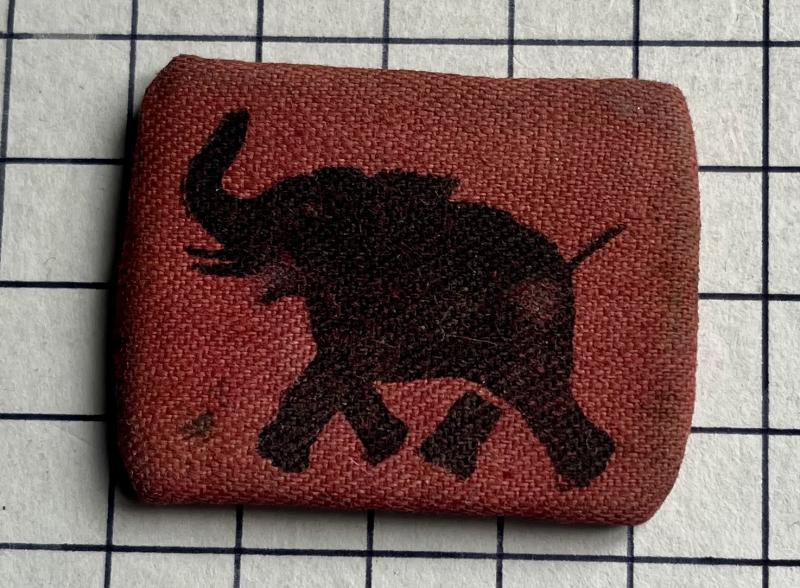
c1940-45 WW2 British IV 4th Corps Printed Formation Sign Patch Badge
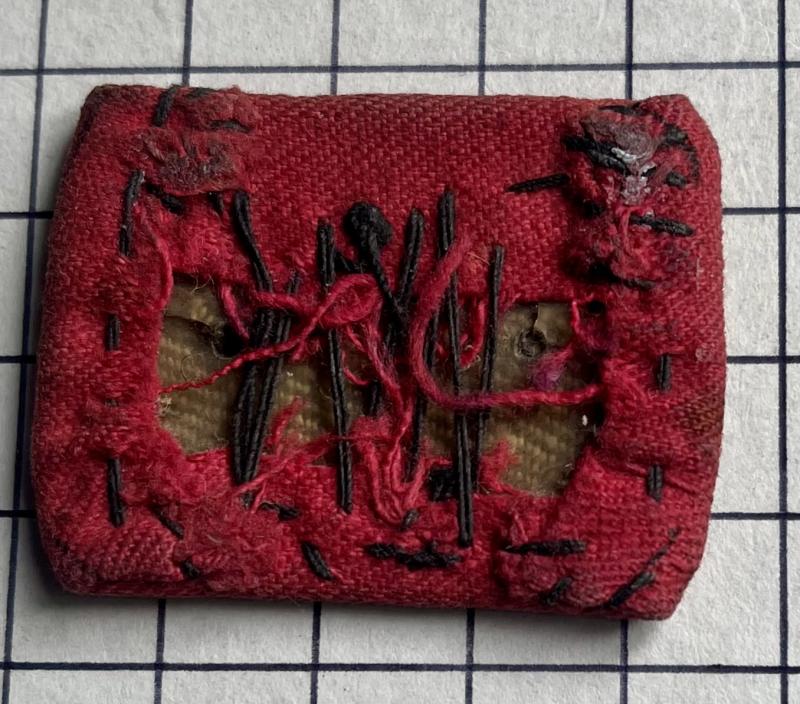
cWWII, 4th Corps printed Formation Sign mounted as per India Burma Campaign. Elephant facing left. Some Service wear.
Ref: BoBD Mills 1014. p.184.
History
Norway
The Corps was reformed in Alresford in Hampshire in February 1940 in anticipation of operations in Norway, or perhaps Finland (part of a projected intervention in the Russo-Finnish Winter War). From March to May 1940 parts of the corps fought at Narvik and Trondheim in the Norwegian campaign. Its commander was Lieutenant General Claude Auchinleck.
Home Forces
After the Norwegian campaign ended, the Corps first commanded most of the armoured reserves preparing to face the proposed German invasion of Britain (Operation Sea Lion), while the other corps headquarters which had been evacuated from Dunkirk in Operation Dynamo were reorganised. IV Corps was envisaged as a counter-attack force under Lieutenant-General Sir Francis Nosworthy.21 Once the danger of invasion was over, the corps was heavily involved in training and developing tactical doctrine. The corps was based at Guilsborough House near Northampton until August 1940 when it moved to Latimer House near Chesham.
Order of Battle Autumn 1940
2nd Armoured Division (16 June–4 August 1940)
42nd (East Lancashire) Division (9 September–6 November 1940)
43rd (Wessex) Division (19 June–5 November 1940)
31st Independent Brigade Group (1 August 1940–15 February 1941)
HQ Royal Artillery
154th (Leicestershire Yeomanry) Army Field Regiment
67th Medium Regiment
Iraq
In January 1942 the Corps headquarters was dispatched to Iraq,citation needed as part of Middle East Command. Its commander was Lieutenant General Thomas Corbett. In 1942, Corbett was appointed Chief of Staff of Middle East Command and Lieutenant General Noel Irwin took over IV Corps.
India / Burma
Following the Japanese conquest of Burma, several British divisions from Britain and the Middle East, and IV Corps headquarters, were deployed to India, then filled out with Indian Army Corps of Signals and line-of-communications units. It took over from the ad hoc Burma Corps headquarters, which was disbanded, at Imphal in Manipur in Northeast India. It reported to the Eastern Army. The Corps adopted a badge of a charging elephant, in black on a red background.
In July 1942, Irwin was promoted to command Eastern Army. His successor in command of IV Corps was Lieutenant-General Geoffry Scoones. It was engaged in patrol activity as far as the Chindwin River and construction of airfields and roads. From late 1943, the Corps formed part of the newly created Fourteenth Army.
In 1944 the Japanese sought to disrupt Allied attacks into Burma by launching an attack, codenamed U-Go, against Imphal, which led to the epic Battle of Imphal. At the start of the battle the Corps consisted of the Indian 17th, 20th and 23rd Divisions, with the Indian 50th Parachute Brigade and 254th Indian Tank Brigade. During the early stages of the battle, the 5th Indian Division was flown into Imphal to join the corps.
The Corps was surrounded by the Imperial Japanese Army but eventually defeated their attackers. Supplies and reinforcements were flown in to support the besieged troops, and casualties and non-combatants were flown out. The siege ended on 22 June, when troops from IV Corps met the relieving forces from XXXIII Corps north of Imphal. From then until the monsoon ended later in the year, formations from IV Corps (the 5th Indian Division and the newly arrived 11th East African Division) cleared the Japanese from east of the Chindwin, and established several bridgeheads across the river.
In November 1944, as the rains ended, Fourteenth Army prepared to make a decisive attack into Central Burma. Lieutenant General Scoones was appointed to Central Command, an army-level headquarters in India, and replaced in charge of IV Corps by Lieutenant-General Frank Messervy. In preparation for the offensive, several divisions were organised as motorised and air-portable formations.
The offensive began with IV Corps on the left of Fourteenth Army, led by the newly arrived 19th Indian Division. It became apparent that the Japanese had fallen back behind the Irrawaddy River. The 19th Division was transferred to XXXIII Corps and IV Corps was switched to the right flank of the Army, advancing down the Gangaw valley west of the Chindwin, led by the East African 28th Infantry Brigade and an ad-hoc infantry formation, the Lushai Brigade. In late February, the 7th Indian Infantry Division won bridgeheads over the Irrawaddy. The motorised 17th Indian Division, with the M4 Sherman tanks of the 255th Indian Tank Brigade, followed up through these bridgeheads and struck deep into Japanese occupied territory to capture the vital transport and supply centre of Meiktila. Reinforced by troops landed at the airfields near the town, it defended against Japanese counter-attacks during March.
Following the Japanese defeat in Central Burma, Fourteenth Army was reorganised. IV Corps now commanded the motorised 5th and 17th Indian Divisions, the 19th Indian Division (which remained on a mixed animal and motor transport establishment) and the 255th Tank Brigade. During April, the 5th and 17th Divisions alternated in the lead of the final drive on Rangoon down the Sittang River valley, while the 19th Division secured the corps' line of communications. By the start of May when the monsoon began, the Corps had been held up 40 miles (64 km) from Rangoon. Rangoon was captured by an amphibious landing, Operation Dracula, having been abandoned by its garrison.
Shortly after the fall of Rangoon, IV Corps was withdrawn from the control of Fourteenth Army and placed under the newly activated Twelfth Army. Temporarily commanded by Lieutenant-General Francis Tuker, it was responsible for mopping up the remaining Japanese forces in Burma until the end of the war including the defeat of a large break-out in the Pegu Yoma. The Corps was deactivated shortly after the end of hostilities.
Code: 2019