
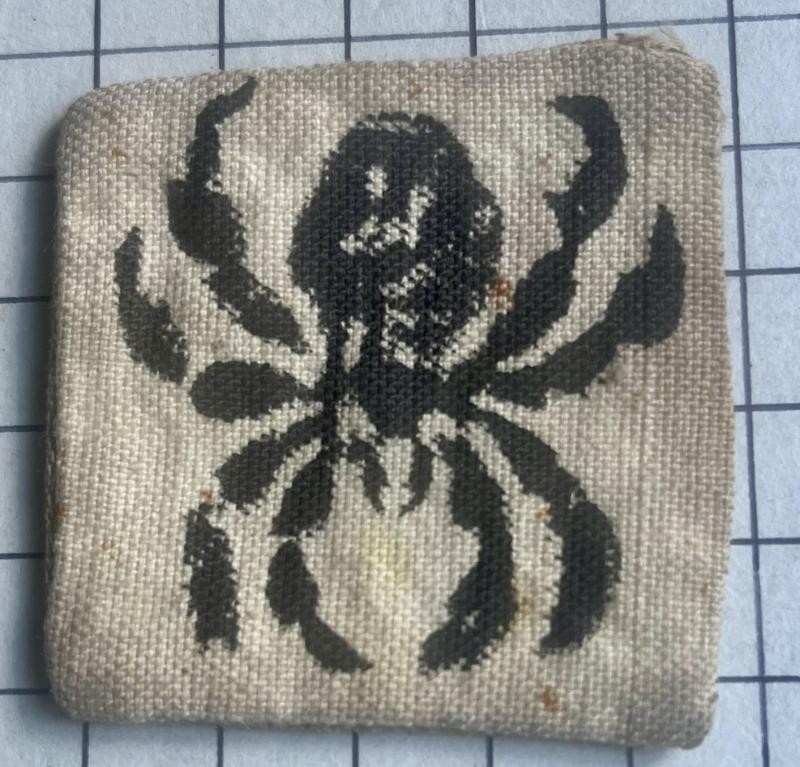
c1943-45, cWW2 Printed British Colonial Army 81st West African Division Formation Sign Badge Patch
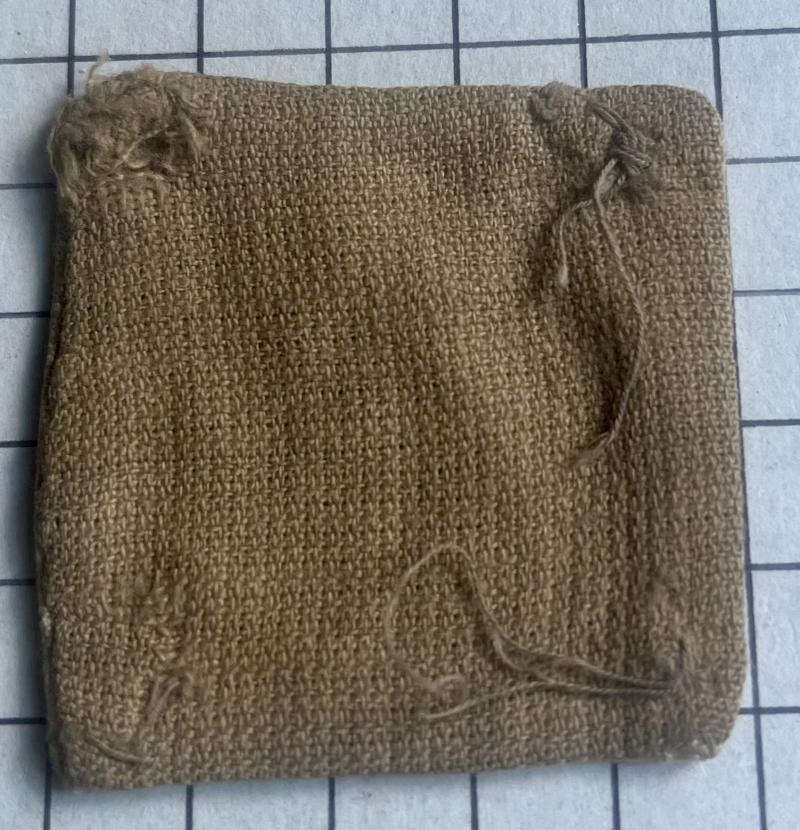
World War II, 81st W. Africa Formation sign featuring a black printed tarantula spider. Affixed to a piece of aertex shirt material, with signs of poppers (removed). Used condition.
Ref: BoBD No 3646, P.761.
The 81st (West African) Division was formed under British control during the Second World War. It took part in the Burma Campaign.
History
The inspiration for the division's formation came from General George Giffard, commander of the British Army's West Africa Command, who subsequently commanded Eastern Army, facing the Japanese army on the frontier between India and Burma. Giffard had wide experience with African troops, and was eager for them to participate in the war. The framework on which the division was formed was the Royal West African Frontier Force. One of the brigades (the 3rd West African) and several of the supporting units which formed the division had already seen action with the 11th (African) Division, against the Italians in East Africa. The division was established as the 1st (West African) Division on 1 March 1943. Three days later it was renamed the 81st (West African) Division, taking the next vacant number in the list of British infantry divisions. The division's badge was a spider, in black on a yellow circular background. This spider was a reference to Ananse, a cunning character in Ashanti mythology, and drawn so that when a soldier raised his weapon to fire, the spider would appear to be going forwards.
The division arrived in India on 14 August 1943. The movement of the 5th (West African) Brigade was delayed, however, after the troopship which was to carry it was lost in the German attack on Convoy Faith off Portugal on the night of 11/12 July 1943. The 3rd (West African) Brigade was detached to the Chindits, and was intended to garrison jungle bases for the raiding columns. The remainder of the division took part in the second Arakan campaign from February to May, 1944, operating in the Kaladan Valley on the flank of XV Indian Corps. In late March, substantial Japanese reinforcements (with some troops from the Indian National Army) outflanked the division and forced it to retreat over a range of hills out of the Kaladan valley into that of the Kalapanzin. In August, the division re-entered the Kaladan valley, forcing the Japanese and Indian National Army to abandon Mowdok, a few miles east of the India–Burmese frontier. The division then advanced down the valley once again, reaching Myohaung near the mouth of the river on 28 January 1945. The division was withdrawn to India to rest on 22 April 1945. On 31 August, it was returned to West Africa and disbanded.
Code: 1995
40.00 GBP