
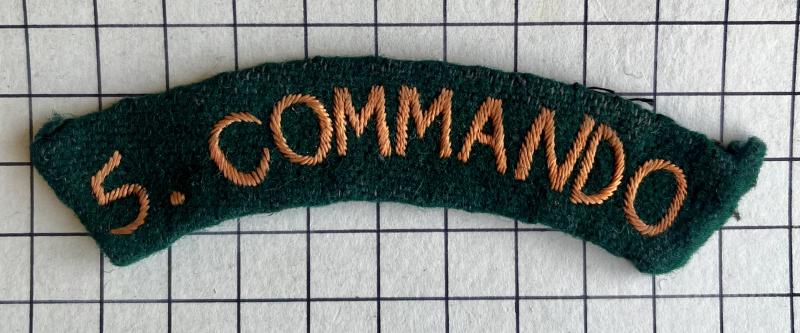
c1943-44 WW2 No. 5 Commando Indian Theatre Made Cloth Shoulder Title Badge
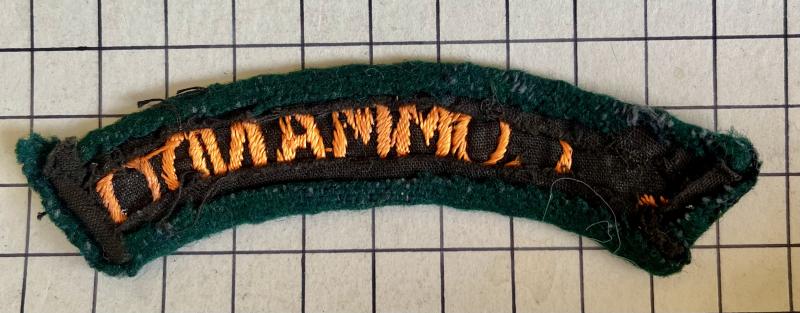
cWWII, rare No. 5 Cdo locally Indian made lovely removed from uniform shoulder title. Typical Indian construction. GC.
No. 5 Commando was a battalion-sized commando unit of the British Army during the Second World War.
Formed in July 1940, the unit took part in a couple of small-scale raids in France in 1941 and contributed some personnel to Operation Chariot before taking part in the landings on Madagascar in 1942. In late 1943 it was sent to India with the rest of the 3rd Special Service Brigade and subsequently took part in operations in Burma throughout 1944 and 1945.
Following the end of the war the unit undertook occupation duties in Hong Kong where they were amalgamated with No. 1 Commando on 23 March 1946 to form 1/5 Commando before eventually being disbanded in February 1947.
By 1943 the commando concept had evolved from the original purpose of small-scale raiding and a re-organisation was undertaken in which the units were organised into formed brigades with administrative, transport and other support elements being inserted into the formations, which became part the divisional-sized Special Service Group headquarters under the command of Major General Robert Sturges. As a result of this, now commanded by Lieutenant Colonel D.M Shaw, No. 5 Commando became part of the 3rd Special Service Brigade under the command of Brigadier Wilfred Nonweiler, along with Nos. 1, 42 (Royal Marine), and 44 (Royal Marine) Commandos.
In November 1943 the brigade embarked for overseas and after a five-week voyage No. 5 Commando, as well as No. 44 (Royal Marine) Commando, arrived in Bombay, India on 19 December 1943 where they became part of Mountbatten's South East Asia Command, which had been set up earlier in the year. They moved by rail from Bombay to Poona where they took up residence at Kedgaon and undertook amphibious landing practice at the Combined Training Centre that had been established at Lake Kharakvasla.
In late February 1944, after the Japanese launched a counter-offensive against the Indian 5th Infantry Division in the Arakan, both No. 5 and No. 44 (Royal Marine) Commandos were moved back to Bombay and embarking on HMS Keren they were sent to Cox's Bazar. They arrived there on 5 March, by which time the British and Indian units in Burma had managed to stop the Japanese counter-offensive and had themselves resumed offensive operations. As Indian XV Corps cleared the Maungdaw–Buthidaung road, the commandos landed behind the Japanese near Alethangaw on 11 March 1944. For a couple of weeks they carried out patrols in the Japanese rear before being recalled to Maungdaw on 23 March, where No. 5 Commando carried out a number of attacks on key terrain.
In April, after the Japanese launched Operation U-Go—the invasion of India through northern Burma and Assam—No. 5 Commando were withdrawn from Maungdaw and moved to Silchar, which was an important communications and logistics hub in southern Assam. For four months they were stationed there, carrying out long-range patrols into the surrounding hills and waiting for the Japanese to arrive. They never made it that far, having been defeated around Imphal and Kohima.
After this a brief period of leave followed before the commandos were moved to Trincomalee in Ceylon, where they joined the rest of the brigade—No. 1 and 42 (Royal Marine) Commandos.
1944–45
They did not remain in Trincomalee for very long, however, for in September the brigade, now renamed 3rd Commando Brigade, was moved to Ramu, near Teknaf in present-day Bangladesh, where they were joined by members of the Special Boat Squadron and began preparing for further operations. Attached to the 25th Indian Infantry Division, throughout November they undertook a number of patrols to islands in the area. In this time, No. 5 Commando was only involved in one such patrol, while the other commandos were more heavily committed, gathering intelligence and carrying out reconnaissance.
In late December 1944 XV Corps, under Lieutenant General Philip Christison, went on the offensive and on 29 December the 3rd Commando Brigade, then commanded by Brigadier Campbell Hardy, carried out an unopposed landing on the island of Akyab. Following this reconnaissance operations were undertaken around the Myebon Peninsula and on the surrounding islands. During one of these patrols, a group of commandos from No. 5 Commando had a brief contact with a Japanese force during which they killed four of them without suffering loss themselves.
On 12 January 1945, the commando brigade carried out a landing on the peninsula. Coming ashore in the second wave behind No. 42 (Royal Marine) Commando, No. 5 Commando carried the advance inland until they came under machine gun fire from a hill that had been named 'Rose' by the planning staff. The following morning, after air support was called in and tanks from the 19th Lancers were came up, No. 5 Commando launched an attack on the position. In the end the attack was successful and as a result of the defenders deciding to fight to the death, no prisoners were taken.
For the next couple of days No. 5 Commando carried out patrols throughout the peninsula as the enemy were cleared from the area, before they were withdrawn back to the beachhead for a couple of days rest. After this the brigade captured the village of Kantha as a preliminary move on Kangow, across a number of waterways on the mainland, where Christison had decided that he wanted to cut the Japanese line of withdrawal. The terrain was difficult with no roads and consisting of mangrove swamps and rice paddies that prevented tanks or artillery coming ashore initially. The whole area was dominated by a small wooded ridge known as Hill 170.
Nevertheless, on 22 January a landing took place, spearheaded by No. 1 Commando, and over the course of the next week or so they and the rest of the brigade were involved in heavy fighting around Hill 170 and the surrounding areas, before finally being relieved on 1 February 1945. During this time No. 5 Commando was placed under the operational command of the 51st Indian Brigade and took part in a number of attacks around positions known as Milford and Pinner, before participating in the final stages of No. 1 Commando's defence of Hill 170, when two troops from the commando reinforced the defenders on 31 January and then took part in beating off the final attack on the following morning.
After this No. 5 Commando and the rest of the 3rd Commando Brigade moved back to Akyab, before embarking for Madras where, after a brief period of leave, they moved to Lake Kharakvasla again to begin training for Operation Zipper, the invasion of Malaya. In the end this operation did not eventuate, as war ended before it could be undertaken
Code: 1880