
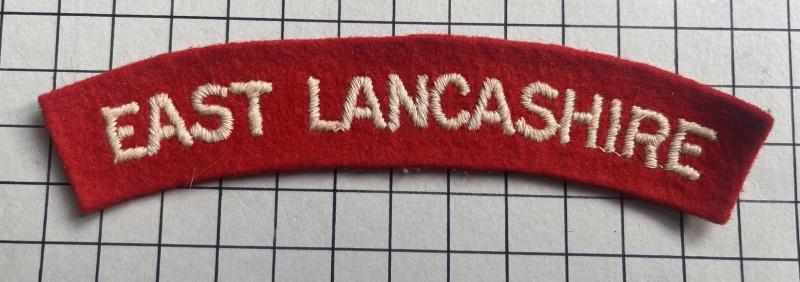
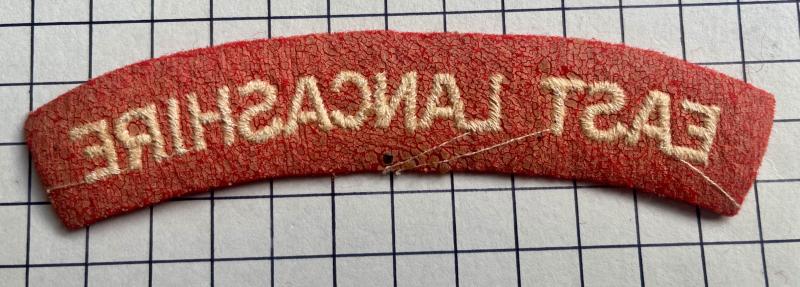
cWW2 East Lancashire Regiment Paste Back Shoulder Title Badge Patch
cWWII, East Lancs Regt paste / glue backed shoulder title. GC.
Prior to the outbreak of hostilities in 1939, the entire Territorial Army was doubled in size, with each unit forming a duplicate. Secondly, a number of wartime battalions were formed.
Battalion Notes Service
1st Regular bn. The 1st Battalion, commanded initially by Lieutenant Colonel James Willie Pendlebury, served in France in 1940 with the 126th Infantry Brigade attached to the 42nd (East Lancashire) Infantry Division. The battalion fought in the Battle of Dunkirk and had to be evacuated to the UK. During the retreat to Dunkirk Captain Andrews was awarded the Victoria Cross. 1944 with 71st Infantry Brigade, transferred to 158th Infantry Brigade, 53rd (Welsh) Infantry Division – 1945.
2nd Regular battalion In British India at outbreak of war. To United Kingdom in 1940. South Africa, Madagascar and East Africa 1942 with 29th Independent Infantry Brigade Group –1943, India and Burma 1943 – 1945.
4th, 1st Line Territorial battalion. Formed 1939 when 4th/5th Battalion was duplicated. North West Europe 1940 with 127th Infantry Brigade, 42nd (East Lancashire) Infantry Division. Following the Dunkirk evacuation, it remained with the division on home defense duties. For most of 1942, the battalion was deployed to Northern Ireland. It then returned to the United Kingdom, and home defense duties, as part of the 76th Infantry Division. In 1944, the battalion became a training formation and was initially posted to the 80th Infantry (Reserve) Division, and finally the 38th Infantry (Reserve) Division.
5th, 2nd Line Territorial battalion. Formed 1939 when 4th/5th Battalion was duplicated.North West Europe 1944–1945. Formed part of 197th Brigade (with the 1/7th Royal Warwicks and the 2/5th Lancashire Fusiliers), 59th (Staffordshire) Infantry Division during its few months in action following the D-Day landings in the area of Galmanche near Epron during Operation Charnwood. Disbanded August 1944 due to manpower shortage.
6th Home Defence battalion formed August 1939. Renumbered 30th Battalion 1941.
7th Raised 1940, transferred to Royal Artillery and converted to 103rd Light Anti-Aircraft Regiment, Royal Artillery, December 1941, served with 55th (West Lancashire) Infantry Division, 61st Infantry Division, disbanded March 1944.
8th Raised 1940 from 50th (Holding) Battalion, converted to 144th Regiment Royal Armoured Corps in 1941 and served in 33rd Armoured Brigade in the Normandy landings on 6 June 1944. The regiment continued to wear its East Lancashire cap badge on the black beret of the RAC. On 1 March 1945 144 RAC was redesignated 4th Royal Tank Regiment to replace the original 4th RTR, which had been lost at Tobruk in 1942.
30th (renumbered from 6th Battalion 1941) Home Defence battalion. Disbanded 1943.
50th Holding battalion. Formed from the East Lancashire company of a Mixed Holding battalion at Huyton; brought to full war establishment by a draft of men returned from the Dunkirk evacuation and renumbered 8th 1940.
Code: 1801
8.00 GBP