
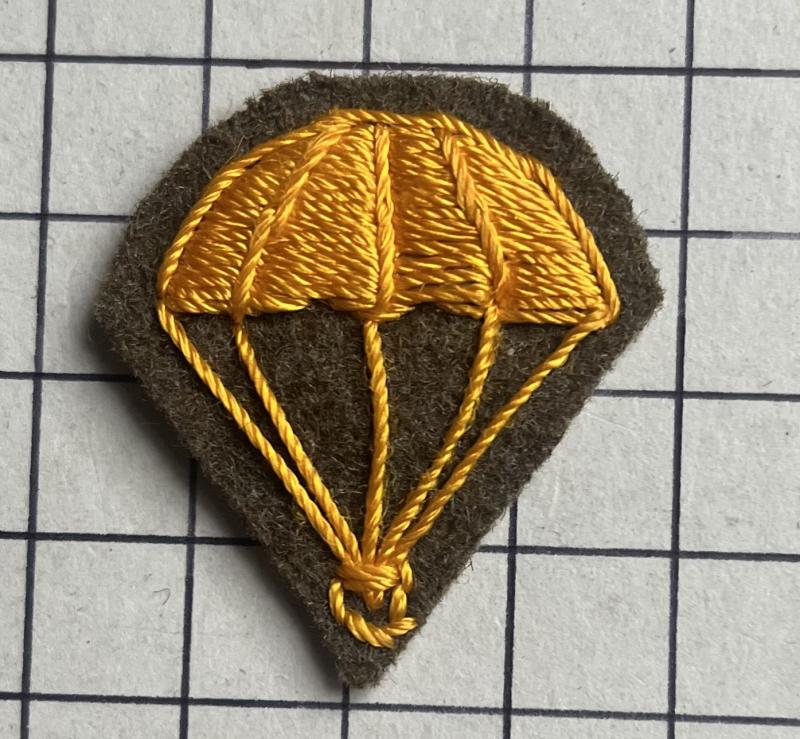
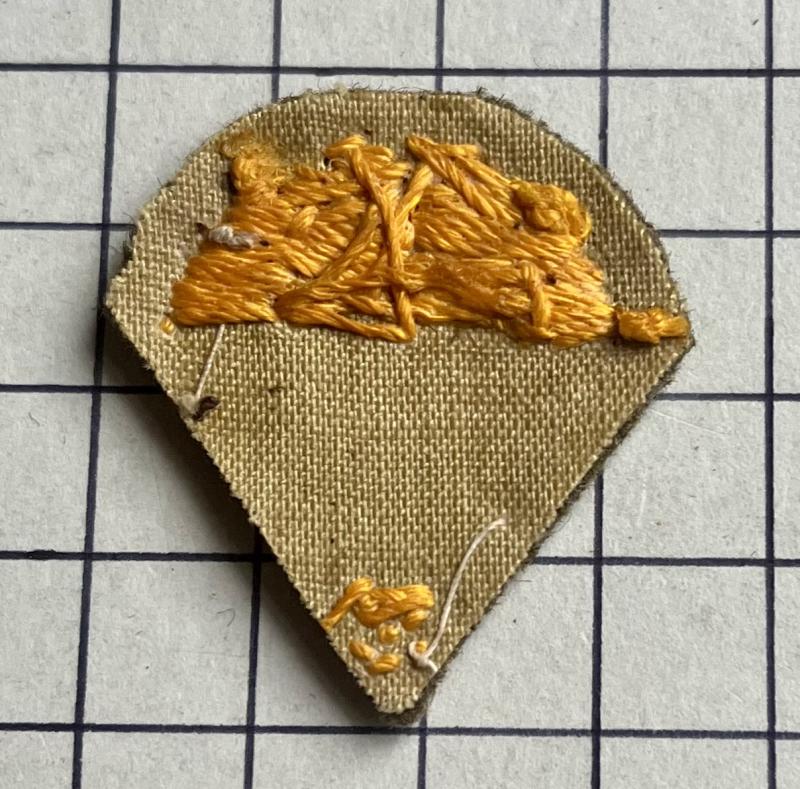
c1949-53 Early Post-War Italian Special Forces Parachute Wing Qualification 'Lightbulb' Cloth Patch Badge
Italy Para qual 'lightbulb' orange embroidered parachute on khaki. VGC.
The Paracadutisti (Italian for "paratroopers") are the elite airborne infantry specialty of the Italian Army, distinguished by their rigorous training in parachute jumps, rapid assault tactics, and high-mobility operations, forming a cornerstone of Italy's special forces capabilities since their inception before World War II.
In the postwar era, the Paracadutisti traditions were preserved and modernized within the Brigata Paracadutisti "Folgore." Following the end of World War II and Italy's accession to NATO in 1949, the Italian Army initiated reforms in the 1950s to rebuild and modernize its airborne capabilities, drawing heavily on U.S. military training and doctrines. Influenced by American special operations practices, early post-war units such as the Saboteurs Paratroopers Company were established, focusing on guerrilla warfare, amphibious assaults, and rigorous selection processes adapted from U.S. Ranger training. These reforms laid the foundation for integrating paratrooper elements into a structured NATO-aligned force, emphasizing elite infantry roles despite limited resources and political constraints on specialized units.14
The culmination of these efforts came with the formal creation of the Paratroopers Brigade on 1 January 1963, initially comprising a command structure, the 1st Paratroopers Regiment (including the 2nd and 5th Battalions), the Saboteurs Paratroopers Battalion, a Carabinieri Paratroopers Company (upgraded to battalion status on 15 July 1963), a Paratroopers Artillery Gun Battery (elevated to group on 1 June 1963), and the Paratroopers Training Centre.
Code: 1799
25.00 GBP