
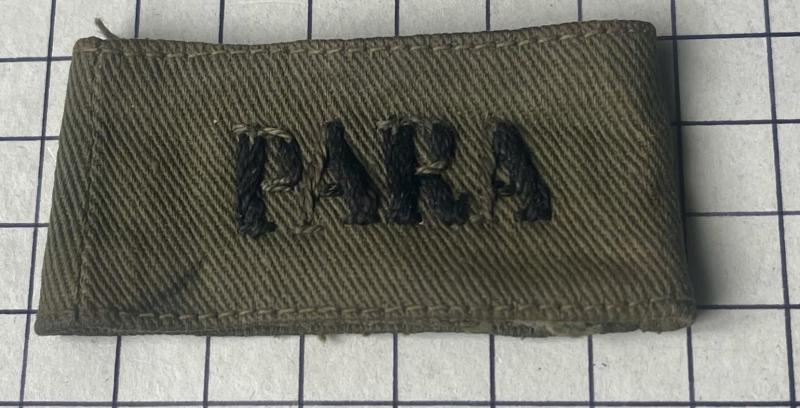
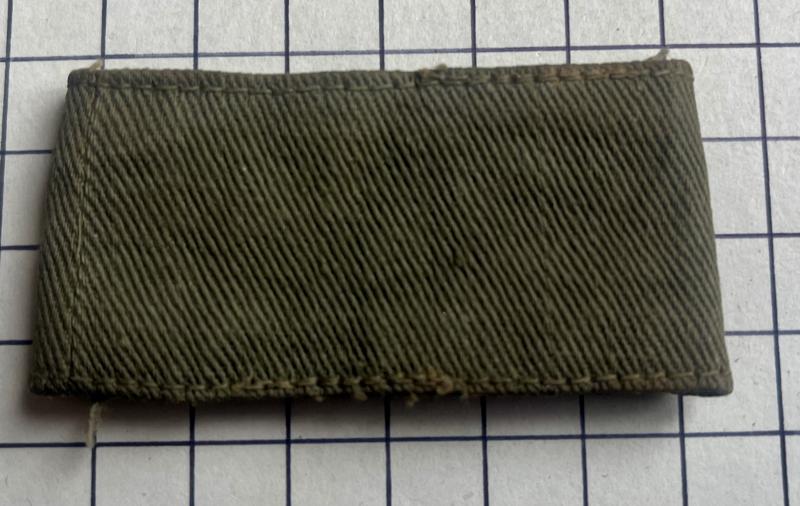
cWW2 British Indian Parachute Regiment Jungle Green Slip-On Shoulder Title Badge
cWWII, rare Indian made British India 'Para' Regt slip-on shoulder title. Used.
The first Indian airborne formation was the British Indian Army's 50th Parachute Brigade, which was raised during World War II on 29 October 1941, initially consisting of 151 Parachute Battalion (composed of British troops), 152nd Parachute Battalion (consisting of Indian troops) and 153rd Parachute Battalion (consisting of Gurkha troops) alongside other support units.
Colonel A.G. Rangaraj, MVC, of the Indian Medical Service and RMO of 152nd Parachute Battalion, became the first Indian, along with Hav. Maj. Mathura Singh to make a parachute descent. In 1942–43, the formation saw limited action at Nara against Pathan tribals in the North-West Frontier Province and conducted some intelligence-gathering missions in Burma, utilizing their somewhat limited airborne capabilities. In August 1943, the 154th Parachute Battalion was formed from troops from the 3rd battalion, 7th Gurkha Rifles and assigned to the 50th Parachute Brigade.2 In March 1944, 151th Parachute Battalion was transferred to Britain, renamed as 156th Parachute Battalion, and assigned to the 4th Parachute Brigade of the 1st Airborne Division.
The 50th Parachute Brigade, without the 154th Parachute Battalion, then saw extensive action at Sangshak and later in the Imphal plains on the Burmese border against two reinforced Japanese divisions. 154th Parachute Battalion had not completed its air training, so it stayed back to attain airborne status. During the Battle of Sangshak (21–26 March 1944), which lasted six days, the brigade suffered extremely heavy casualties, totalling 40 officers and VCOs and other 545 ranks, winning the appreciation of Lt. Gen. William Slim, the commander of the British Fourteenth Army. The breakout on the night of 26 March 1944 saw the remnants of the once-proud parachute brigade fight their way south and then west through the Japanese-infested jungles to Imphal. It achieved its task of preventing the flanking Japanese forces from surrounding Imphal and destroying IV Corps. Despite the losses it suffered in Sangshak, the paratroopers formed ad hoc units and continued to participate in actions to destroy Japanese forces near and around Imphal until their withdrawal at the end of July.
Code: 1784